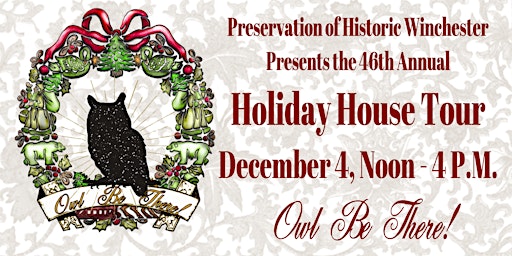
46th Annual Holiday House Tour - Owl Be There!
Other
306 East Piccadilly Street,Winchester VA 22601
04 December, 2022
Description
Preservation of Historic Winchester welcomes you back to our signature fundraising event. Guided tours of three private homes will lead you through building styles of the 19th century, while the fourth site will take you to a Georgian-style church. Stop by our pop-up holiday shop in our office at the Hexagon House for sweet treats, holiday décor, and fresh greenery before or after the tour. You don’t want to miss our year-end celebration – Owl Be There! The tour will not be rescheduled for inclement weather. Call (540) 667-3577 or watch our Facebook for announcements. Be prepared to spend some time waiting outside and wear comfortable, low-heeled shoes. No photography inside private residences, please! PHW would like to thank our major sponsors Stephanie Ryall of Realty One Group Old Towne and Bank of Clarke County Foundation, as well as advertising sponsors Colony Realty, Lisa T. McCoig CPA, Winchester Little Theatre, Peter Bullough Foundation, Belle Grove Plantation, Wells Fargo Advisors, Angel's Root Quilts, and Maral Kalbian. A digital copy of the program booklet can be found at https://drive.google.com/file/d/1aAtm5tNrQ_DP4y1jOSEXrRmkZQKMrefA/view?usp=sharing Our four tour sites are: 119 East Clifford Street This vernacular brick building was likely built circa 1850 by Philip Hansucker, who apprenticed wagonmaking with Philip Sherer of nearby 125 E. Clifford St. The families became intertwined further when Hansucker married Caroline Sherer, Philip Sherer’s niece, on Christmas Day, 1849. By 1860, Philip Hansucker took on Sherer’s wagon and plough making business and brought his brother into the enterprise as a blacksmith. He served as a Winchester city councilman from 1861-1865. Shortly after the Civil War, the Hansucker family moved to Millwood. As is common with vernacular buildings, the home was expanded throughout the 19th and 20th centuries in architecturally compatible ways by its new owners, particularly through adding dormer windows, additions to the rear of the building, and a Colonial Revival style porch with a half-hipped roof supported by Tuscan wood columns. Initial work to preserve the building was undertaken circa 1974 by Lawrence and Catherine Bell, including restoring the wide pine flooring and opening fireplaces. The home received a Winchester Historic Building Plaque in 1984. The current owner has been working for two years to use her interior design skills to bring new life to this old home. Her eclectic collection includes found objects and antiques, beautifully repurposed to blend with elements of modern décor. Christmas tree ornaments honor the owner’s favorite southern traditions, and garlands of fresh greenery adorn old pine mantels. Visitors will see the old outbuildings in the back yard, likely used in the wagonmaking business. 202 South Washington Street As you approach the front door of this brick Romanesque Revival style home, look down. A white marble slab engraved with “J. B. Russell” welcomes you to this circa 1890 masterpiece. By the time James B. Russell built his magnificent home on the corner of Washington and Cork streets, he had served as a Frederick County deputy sheriff, a Winchester City councilman, businessman, and President of the Union Bank. The first story of the façade is defined by three round-headed arches providing a recessed entry to the home. A soldier course of bricks delineates the first and second stories of the building, while a basketweave brick frieze encircles the top of the second story. An integral porch supported by Tuscan columns and capped with dentil molding is located in the central bay of the second story. Directly above it, a dormer clad with slate shingles with a half-hexagonal-on-hip roof overlooks the front yard. Recently purchased by Jennifer Wolgamott, the home survived a period of use as apartments remarkably intact. The interior features pocket doors, oak wainscoting, period fireplace mantels, and stained glass windows. 216 South Cameron Street This circa 1880 Italianate-style home is a blend of traditional and modern construction inside and out. From the second story to the roof, the house reflects its historic nature with its side-gabled standing-seam metal roof, scrolled modillion cornice, and 2/2 double-hung windows crowned with brick jack arches. The first floor of the building was modernized after it was struck by a vehicle in the mid-twentieth century. A picture window and a brick stoop with an integrated flowerbed were installed during the façade reconstruction. Before entering the home, look up to see the stained-glass transom window above the paneled front door. Theodora Hargraves purchased the building in 1976 as a single woman, raising her daughter and operating the Winchester Art Company here. She was joined by her husband Rodger in 1989. The wreath on the front of the house will be a nod to the missing architectural detail and will reflect the traditional design aesthetics of the Historic District. One room will feature the photography by Tracey Robertson, the owners’ daughter, as part of the holiday decorations. A hand-crafted peacock piñata will be hung in the rear garden which will be seen as visitors exit the home (no bird bashing pole will be provided). 306 East Piccadilly Street The Old Stone Church dates to 1788 according to the date incised on the western wall. The church has watched Winchester grow from a frontier outpost to a modern city over 230 years. The limestone Georgian-style meeting house is the last complete example of the churches that once lined the gentle hill just outside the original town limits. The simple structure is typical of the austere stone meeting houses erected by the Presbyterian settlers. It bears numerous similarities to the Paxton Presbyterian Church constructed in 1740 in Paxtang, Pennsylvania. The broad window openings have upper and lower sashes of twenty panes, an unusual feature in a Valley church. A smaller window in the north wall, with six-over-six sash, lights the pulpit. Massive shutters with raised panels are used at each of the windows. Additionally, the entrance doors have raised panels and a ten-light transom above both entrances. Hardware for the shutters and doors was handwrought by a Philadelphia blacksmith. The church’s present appearance is due to a major restoration effort begun in 1941. The building suffered damage and indignity throughout the Civil War, after which, it was used as the Winchester Colored School and a Virginia State National Guard armory. Through a sensitive, scholarly restoration, the building now resembles its original state, and thus provides insight into the religious life of Virginia's early Presbyterians. Now owned by the Old Stone Foundation, this group seeks to continue this work in maintaining the building. The next major challenge for Old Stone Church is a modernized and efficient heating system. The group plans in the future to use the building as a museum.
Discussion
By posting you agree to the Terms and Privacy Policy.