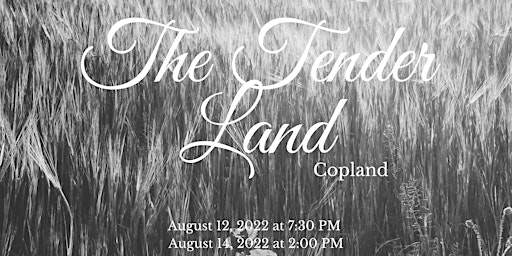
The Tender Land, Copland
Other
515 East Thacker Street,Des Plaines IL 60016
14 August, 2022
Description
CREATIVE TEAM Director: Colter Schoenfish Musical Preparation: Fumiyasu Kawase During the Great Depression, the Mosses, a farming family in the rural Midwest, anticipate both the spring harvest and the high school graduation of their eldest daughter, Laurie. One day, the youngest daughter, Beth, plays and dances with her doll in front of the family farm. The family hears troubling news of two wandering strangers who have been assaulting local girls. Shortly afterwards, two itinerant farm workers, Top and Martin, arrive seeking work and are hired to help with the harvest. Laurie, who is torn between loyalty to her family and a desire to leave the farm to pursue her own dreams, shares a strong connection with Martin and is enthralled by the strangers’ tales of their wanderings. Laurie and Martin develop romantic feelings for one another, leading them to kiss at Laurie's graduation party. Laurie's mother and grandfather have already harbored suspicions about Top and Martin and believe they may be the ones attacking women in the community; the kiss is the final nail in the coffin. Grandpa Moss tells the men they must leave in the morning, even when it becomes clear that they are innocent of the local crimes. Laurie and Martin dream of running away together, but in this Depression-era exploration of the American Dream, will their optimistic plans and young, simple love be enough to sustain them? Ultimately, Laurie must decide what she owes to her family and what she owes to herself. The master of a uniquely American sound, Copland premiered The Tender Land, his only full-length opera, in 1954. It was initially panned by critics and received unenthusiastically by audiences due to its departure from standard operatic expectations. Today, critics like Christopher W. Patton argue that its simple plot should not obscure its “broad relevance and emotional appeal.” Copland's librettist, Erik Johns, called the opera more of an “operatic tone poem” than a traditional opera and Patton calls it a “meditation, an attempt to capture the ephemeral, cyclical nature of time.” Note: General social distancing guidelines will be encouraged. For the safety of our audience, the theatre will not be at full capacity. We encourage unvaccinated audience members to wear a mask.
Discussion
By posting you agree to the Terms and Privacy Policy.