Film Screening: The Lady from Shanghai
Other
43 York Street,Portland ME 04101
27 May, 2022
Description
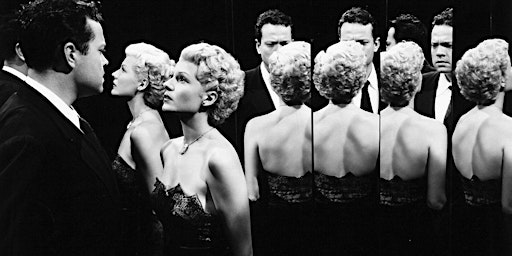
Orson Welles's 1947 "brilliant, brash noir" starring Welles himself and his soon-to-be ex-wife Rita Hayworth In his 1947 sizzler, The Lady from Shanghai, Orson Welles takes Sherwood King’s forgettable two-penny mystery novel and creates a what critic Chuck Bowen calls an “overstuffed, wondrously weird” film noir, with Brechtian overtones peppered throughout the dialogue, and ambitious cinematography whose dazzling visual effects often border on the surreal. The story follows Michael O’Hara (played by Welles himself), a wayward Irish sailor, whose attraction to the beautiful Elsa Bannister entangles him in a fake murder plot gone awry, driving him in turn to accept legal help from Elsa’s husband (that's right), a disabled and embittered criminal lawyer. The ravishing Elsa is played by Welles’s estranged spouse Rita Hayworth; their divorce was finalized in 1947, the year the film was released. (Welles famously insisted that Hayworth cut and dye her iconic red locks for the part of the titular Lady, causing speculation that he was trying to sink Hayworth’s career.) True to its genre, the film’s overt misogyny was not limited to its production; as Elsa, Hayworth was compelled, through the power of her dizzying charisma, to create a memorable character out of a role written to be merely a continuation of her popularity as a pin-up girl. If the film falls short of being a classic, the problems associated with it are certainly classic examples of the struggles between Orson Welles and the studios that would plague Welles’s oeuvre. As with 1942 period drama The Magnificent Ambersons, Columbia Pictures took a scalpel to The Lady from Shanghai post-production, editing away nearly an hour of footage in an attempt to streamline the film into a narrative cadence more typical of the film noir genre. (This is to say nothing of the studio’s interference during the film’s production, which resulted in a staggering number of unhappy re-shoots.) And yet, there is much to relish in this carnivalesque noir. It was shot between San Francisco, Sausalito, and the Zaca, a schooner owned by the legendary onscreen swashbuckler Errol Flynn (who also makes a cameo in the film). Cinematographer Charles Lawton experimented with new lighting techniques to add a stark, unsettling character to the film’s visuals—an effect heightened by grotesque backdrops for the drama, most peculiarly, San Francisco’s Steinhart Aquarium. Orson Welles’s naïve Michael stands out among his other onscreen performances, which were so frequently defined by his rakish, morally ambivalent charm, and his gently aspirated Irish intonations alone are worth the price of admission. The result of all these contradicting visions and mismatched personalities is a gorgeously idiosyncratic 1947 period piece—punctuated by great cinematic moments in which Welles’s deft and distinctive authorial voice breaks through. Film details: Country: USA Language: English Running time: 96 minutes Format: 16mm (vintage print) Director: Orson Welles About Kinonik Kinonik is a 501(c)(3) not-for-profit organization whose mission is to enlighten and entertain audiences of all ages through projected screenings of celluloid classic films. Our current archive consists of more than 500 16mm films. A century into the film industry, digital offers myriad options for viewing media that the pioneers of the film industry surely never envisioned. While the benefits of accessibility can’t be argued – something is missing. Films have been created to give audiences the shared experience of temporary escape from the mundane into a world of heightened emotions and suspense that give them license to laugh, cry, gasp, chortle, and even shriek together. The streaming experience is essentially solitary. The theater experience is unfolds with a community of many. The more solitary our world gets the lonelier our world gets and the less we experience common experiences. This is the magic of movies; it’s the difference in nuance between sprocketed frames of real images speeding past the bright bulb of a projector than the digitized experience of pixels on a flat screen. We’re committed to preserving the film experience through the real-deal – projected screenings of must-see silent and sound classics.
Discussion
By posting you agree to the Terms and Privacy Policy.