Meet the Candidates for School Committee - Part 2
News
Medfield MA
06 March, 2022
8:01 AM
Description
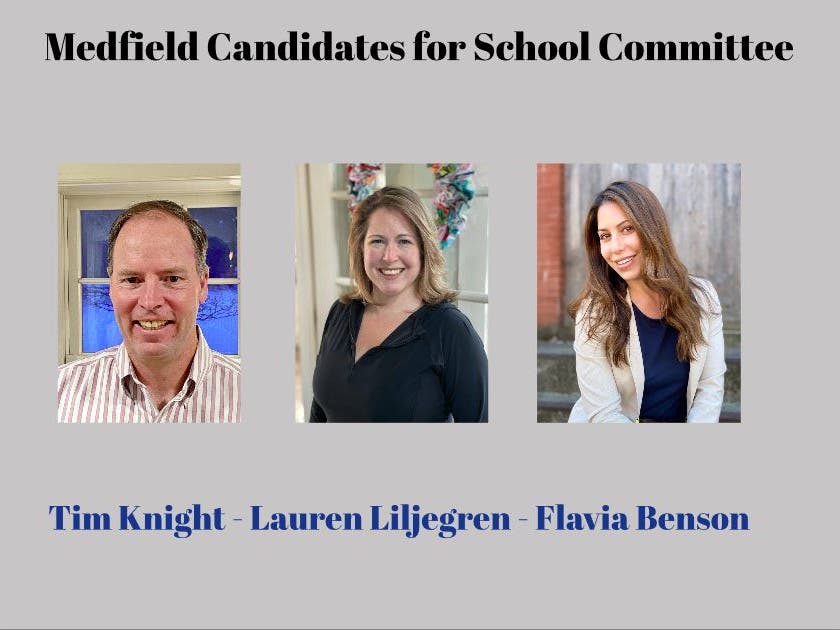
Meet the School Committee Candidates (Part 2) This is Part 2 of a 5 Part Series, giving the voters in Medfield an opportunity to learn about the School Committee candidates. One candidate, Robert Worth, has withdrawn from the race, leaving three candidates vying for two seats. Here is a statement from Robert Worth to the Medfield Community regarding his withdrawal: "Over the past week, it has become increasingly clear to me that I would need to make the difficult decision of withdrawing my name from the school committee election this year. Simply put, I do not currently have the personal bandwidth to be fully committed to the race, and if elected, to the important position of a school committee member. Although I remain extremely passionate about the education of students in Medfield, it would be unfair to voters, and the larger community, if I continued to pursue this elected position. I thank the community for all the support during both the prior election and the election this year. Thank you to all of those who signed papers for me, put signs in their yards, and supported me throughout the process. I know that no matter who is elected to the school committee this year, Medfield students will continue to learn, grow and thrive. I wish the other candidates the best of luck" The School Committee Candidates Flavia Benson, Tim Knight (incumbent), and Lauren Liljegren have answered Part 2 questions below: Question 1. If voted onto the School Committee, what would be your top 3 priorities? Tim Knight (incumbent): I have learned as a current School Committee member how important it is to partner with the Medfield community to support our student's success emotionally, academically, and socially. While operational challenges will vary year to year, my current priorities include ensuring Medfield provides a best in class environment for world-class education, continued focus on the social/emotional needs of our students and staff as we exit the pandemic, and fostering improved communication and community across the district. These are summarized below: Environment for Learning - Partner with Town leadership to complete and fund a community supported plan to address Dale Street school, while continuing to invest and modernize technologies, equipment, and building facilities in all schools. Communication - We must improve the systems to make it easier for community members to provide input to the schools, with a focus on streamlining two-way communication at each school. Community Partnerships- The Medfield Schools are central to the community, and must work harder to strengthen the sense of community across the town. We must promote increased engagement and collaboration with organizations such as PTO, MCPE, SEPAC, MEMO, and MAP. Finally we must work hard to ensure school sponsored subcommittees & task forces have broad representation from the community, model positive values, and drive continuous improvement across the community. Pandemic Transition - Work harder to address the social/emotional impact of the pandemic with a focus on better understanding the needs of every student, while ensuring we support, retain, and recruit the best educators in the state. Lauren Liljegren: As a school committee, every decision and financial investment we make must increase student achievement and benefit the larger Medfield community. In everything we do, we must serve those primary interests. Some examples of ways I would work to serve those interests are: Ensuring the next plan to replace Dale Street School passes. We can't afford another failed plan and our children and staff shouldn't have to wait any longer for a new school. Citizen feedback must be better incorporated into our decision making. Medfield High School continues drop in publicly available school rankings, while neighboring districts climb. We need to determine the root cause(s) of this steady decline and course correct. For example, when surveyed, most parents and Blake Alumni were dissatisfied with Standards Based Reporting at the middle school. A project was undertaken to shift the grading methodology, though the resulting changes do not reflect parent or student feedback. Why are we still using SBR at Blake? We are frequently surveyed, though the resulting feedback is often hard to find and not reflected in the ultimate decision. Parents and taxpayers increasingly feel their voices are not heard. Many parents have noted they feel dismissed by our elected School Committee. Regular public forums would create transparency and a two-way dialogue. Flavia Benson: My goal, as a School Committee member, is to reflect the diversity of the town in interests and concerns, and to be a voice for students, parents, and taxpayers. My priorities are addressing the educational gap caused by pandemic measures, providing health optimized environments, and the need for a new school building. Studies demonstrate that restrictive measures caused educational gaps amongst students, and detrimentally affected the social and emotional well-being of kids, particularly those students with disabilities. As we move towards normalcy, focus must shift to closing the educational gap caused by disparity in resources during the pandemic and addressing the social and emotional well-being of our students. It is paramount to prioritize measures - curriculum and programs - within the schools that will adequately deliver educational equity to the student population allowing our student body to thrive. Pandemic measures were not ideal for creating sustainable healthy building environments for staff and kids in our schools. This included excessive use of chemicals, many dangerous to children, staff, and the environment. In 2020, the EPA began promoting healthy learning environments through grant initiatives. As an expert in environmental infection prevention, we need to adopt programs that support health and safety, thereby improving academic performance, reducing absenteeism, and reducing environmental hazardous. Regarding the pressing need of a new school building for 4th & 5th grades, I would prioritize a project at the current Dale Street site, with engagement from parents and taxpayers, while focusing on fiscal responsibility and minimizing environmental impact. Question 2. As a member of the School Committee, what strategies would you utilize in managing and/or avoiding conflict in a committee decision-making process? Tim Knight (incumbent): While managing conflict is part of every group activity, my strategies will vary depending on a number of factors. I typically try to understand if I am joining a newly formed or established committee, the personalities, political landscape, topical sensitivities, and outcome the committee is attempting to improve before formulating a strategy. Below are themes and best practices I have learned after serving on dozens of school, volunteer, or business related committees. Respect for all committee members and agendas. Diverse representation of committee members who are appreciative of input from all members and open to new ideas. Strong culture advocating win-win decisions over win/lose decisions. Realization that contentious decisions take time, and require consideration around what is good for the whole and not just one group. Structure to promote winning conditions - a few examples are below: Clear Problem Statement, Goal and definition around member Roles & Responsibilities. Leader empowered to move the group forward. Process incorporates views of all citizens who are impacted by the decision, along with ongoing input from all committee members. Robust governance and communications. I take pride in being a reliable teammate who effectively addresses conflict, and supports consensus building in a way that contributes to a positive climate and culture across the committee. Lauren Liljegren: The lack of diverse opinions on the Medfield School Committee has proven both ineffective and expensive for our town. Ineffective for children and their parents; Expensive for taxpayers. For example, in the recent town vote to allocate funds for a Dale Street School replacement, 51.8% of our town voted "no", while 100% of our School Committee voted "yes". Over $600,000 of taxpayer money was wasted on a failed plan and we don't currently have a path forward for a necessary, new school. If the make-up of the School Committee better matched the make-up of Medfield, perhaps all our work would have resulted in a passing plan. What could our school district do with an extra $600,000 right now? What would staff and student retention look like if we were breaking ground for a new school? Diversity in groups often does increase conflict, though diverse groups are more likely to achieve objective goals than homogenous groups. Passive-aggressive college roommates avoid conflict. Elected School Committee members are expected to speak up on behalf of the community they serve. I will. Flavia Benson: As an attorney for the past 18 years, and in-house counsel and executive leader for the past 6 years, I am well versed in conflict resolution strategies and managing conflict effectively within and outside of my organization. A lack of conflict, in any working environment, but specifically within an elected body, should be concerning as the same would fail to address differing interests within a community. Conflict, managed through open-mindedness with increased participation translates into effective problem solving, and cohesiveness which allows team members to work together in finding common ground for the larger goal. Conflict is an inevitable reality of all relationships, both personal and working. The differentiator between successful and unsuccessful conflicts, many times, has to do with allowing personalities and individual "likes and dislikes" to outweigh discussions and decisions that are based on facts. We must first agree that it is ok to disagree. A key strategy in managing conflict is to increase engagement by establishing guidelines where every member has an opportunity to be heard without interruption. Actively listening is an essential part of understanding differing viewpoints. Identifying the points of agreement and disagreement amongst members is the next important step. Once common ground is determined, looking at that bigger picture will promote balance, flexibility, and adaptability. As a member of the School Committee, I will use my skills to promote a safe open-discussion environment, with the objective of finding common ground in what is best for our district.
Discussion
By posting you agree to the Terms and Privacy Policy.