Progressive Party of Massachusetts Revisited: Part 1
News
Boston MA
29 September, 2021
5:23 PM
Description
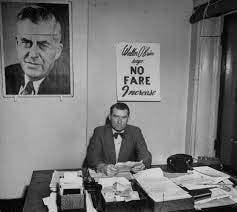
If you feel that neither the corporate-sponsored Republicans nor the corporate-sponsored Democrats offer much of an electoral alternative for anti-corporate Massachusetts voters these days, your feeling is not an historically unique one. After World War II, Massachusetts supporters of Henry Wallace's unsuccessful 1948 Progressive Party presidential campaign attempted to provide politically progressive voters in Massachusetts with an electoral alternative to the Democrats and Republicans by forming the Progressive Party of Massachusetts. By the mid-1950s, however, the Progressive Party of Massachusetts had pretty much disappeared as a factor in Massachusetts electoral politics. But one of the campaign songs for its 1949 Boston mayoralty candidate, "The MTA Song", was recorded by The Kingston Trio in the late 1950s and remained on Billboard's "Top 40" list of hit records for six weeks during the summer of 1959. In its 1952 platform, the Progressive Party of Massachusetts characterized the political situation in Massachusetts at that time in the following way: "Today fear and desperation are in tens and thousands of Massachusetts homes… "Stop the shameless corruption and chiseling, the politicians' junkets and sheer waste and inefficiency and tens of thousands of dollars would be available for the real needs of the people of Massachusetts. "Second, end the greater graft and chiseling represented by Massachusetts' outrageous income tax law, under which the man who gets a hundred thousand dollars pays at no higher rate than the worker who earns $2500. The burden of all our state activities is shifted onto the shoulder of our working people. Taxation according to ability to pay thru a graduated income tax law, would make millions of dollars available for state needs…" In its 1952 platform, the Progressive Party of Massachusetts also called for such things as: 1. A public works program to provide jobs for unemployed Massachusetts residents; 2. An end to "Jim Crow policies of public utilities (gas, electric, telephone, etc)" in Massachusetts "who employ the basic minimum number of Negroes;" 3. A stop to police brutality and racist attacks in Massachusetts; 4. A state rent control law; 5. Tax exemption for small homeowners; and 6. Free state college education for all qualified youth in Massachusetts. In its Nov. 17, 1952 post-election analysis, however, the Progressive Party of Massachusetts indicated why--despite its visionary platform and its popular anti-war position--it failed to attract many Massachusetts voters during the Korean War era: "…There is an automatic distrust of the Progressive Party and of everything that they propose. "…There is considerable isolation between progressives which prevents that all important feeling of oneness. "These realities are best understood if we delve for a moment on the root causes. Most outstanding is our lack of personal contact in the community. By this is meant that while we take certain issues and enter the community to get petitions signed, distribute leaflets…we lack the all-important factor of developing a person-to-person relationship. "Clearly related to this question is our lack of follow-up on the contacts that we do make… "Of course not to be overlooked was the general black-out of all news of the Progressive Party in the press, radio and TV. This lack of fair presentation of the fact that there was an opposition party contributed in no small way to the size of our vote and our inability to reach people effectively…" (end of part 1)
Discussion
By posting you agree to the Terms and Privacy Policy.