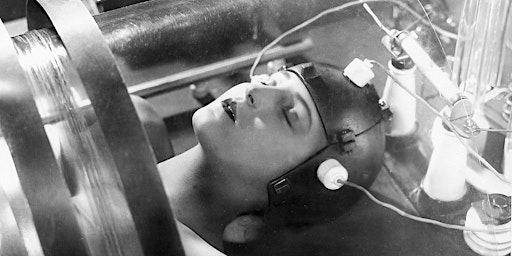
Metropolis (1927) directed by Fritz Lang
Other
121 Cassidy Point Drive,Portland ME 04102
12 April, 2023
Description
In a futuristic city sharply divided between the working class and the city planners, the son of the city's mastermind falls in love with a working-class prophet who predicts the coming of a savior to mediate their differences. - IMDB Metropolis is a 1927 German expressionist science-fiction film directed by Fritz Lang and written by Thea von Harbou in collaboration with Lang. The silent film is regarded as a pioneering science-fiction movie, being among the first feature-length movies of that genre. Made in Germany during the Weimar period, Metropolis is set in a futuristic urban dystopia and follows the attempts of Freder, the wealthy son of the city master, and Maria, a saintly figure to the workers, to overcome the vast gulf separating the classes in their city and bring the workers together with Joh Fredersen, the city master. The film's message is encompassed in the final inter-title: "The Mediator Between the Head and the Hands Must Be the Heart". Lang created one of the unforgettable original places in the cinema. “Metropolis” fixed for countless later films the image of a futuristic city as a hell of material progress and human despair. From this film, in various ways, descended not only “Dark City” but “Blade Runner,” “The Fifth Element,” “Alphaville,” “Escape From L.A.,” “Gattaca” and Batman's Gotham City. The laboratory of its evil genius, Rotwang, created the visual look of mad scientists for decades to come, especially after it was so closely mirrored in “Bride of Frankenstein” (1935). The device of the “false Maria,” the robot who looks like a human being, inspired the Replicants of “Blade Runner.” Even Rotwang's artificial hand was given homage in “Dr. Strangelove.” Although Lang saw his movie as anti-authoritarian, the Nazis liked it enough to offer him control of their film industry (he fled to the United States instead). Some of the visual ideas in “Metropolis” seem echoed in Leni Riefenstahl's pro-Hitler “Triumph of the Will” (1935) — where, of course, they have lost their irony. Kinonik's 16mm print of Metropolis has a musical soundtrack and is approximately 93 minutes long; the original film was cut by the studio after its initial premiere. Metropolis has recently been restored with footage added from a 16mm print found in Argentina and footage recovered in New Zealand,
Discussion
By posting you agree to the Terms and Privacy Policy.